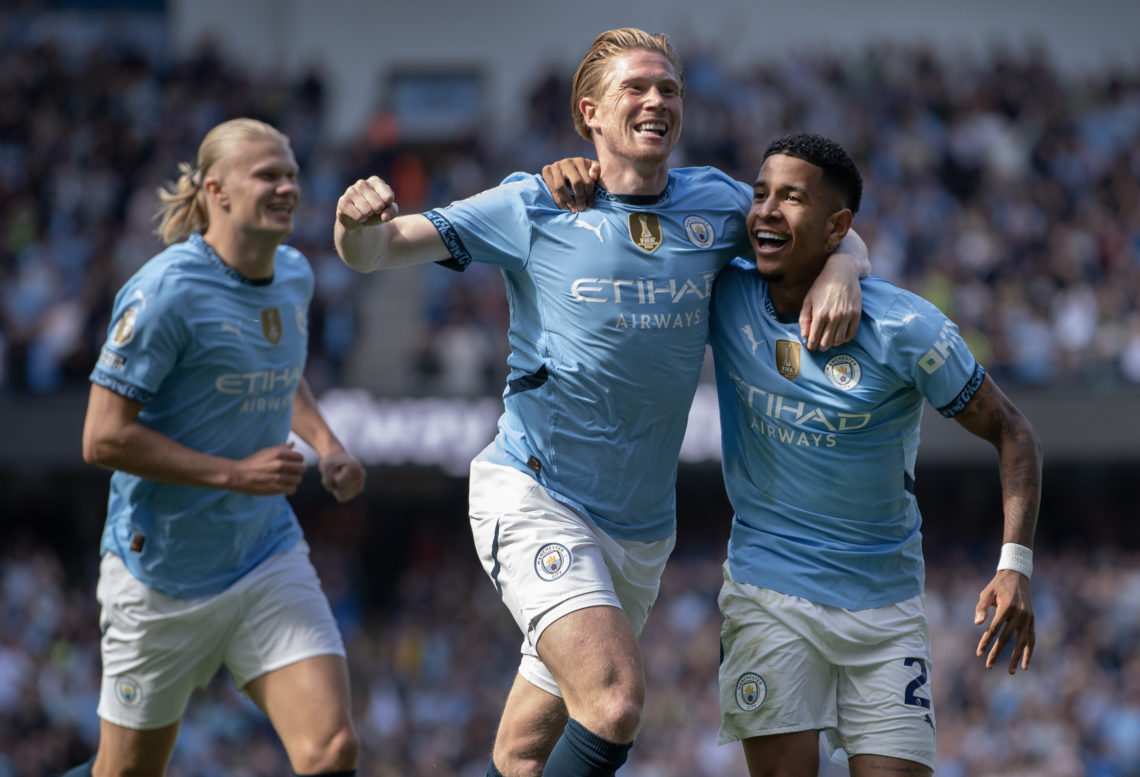


Every season, Pep Guardiola seems to find ways to make his Manchester City players even more dangerous than before in various ways.
Guardiola perhaps realises the risk of opposition managers figuring out how to minimise the threat that his team poses and as a result, he tinkers his tactics and the way he profiles players.
The £378,846-a-week manager is widely praised for being a step ahead of the rest and one way he manages to ensure that remains the case is ensuring his players’ strengths are always highlighted.
For instance, with Erling Haaland being able to occupy defenders with his domineering presence and being able to run the channels due to his searing pace, Pep Guardiola ensures that he stays up the pitch rather than dropping deep to collect the ball.
In this respect, Haaland’s mere presence can allow his Manchester City teammates an extra yard of space to either create chances for him or score goals.
For instance, one of the key factors behind why Phil Foden had the room to pick his spot and launch the ball into the top corner against Real Madrid last season was due to the Norwegian occupying the opposition backline.
While Haaland deserves to be praised for performing the instructions to a tee, so does Guardiola for profiling him correctly for the benefit of his side.

Pep Guardiola has identified new De Bruyne role where he is already thriving
This season, it seems like the Catalan boss has identified a brand-new role for Kevin De Bruyne.
Against both Chelsea as well as in City’s latest 4-1 win against Ipswich Town, the £54.5 million man’s presence was not as prevalent on the right-hand side of the final third or in central zones as much as previously.
As per the Belgian’s pass map from the contest — via Mark Stats on X — the positions he took up against Kieran McKenna’s side make for interesting viewing.
Several of the positions De Bruyne occupied were on the left-hand side of the pitch, akin to a left-wing position, especially in the first half.
Pep Guardiola trialed a 3-1-6 system in possession in his Premier League opener against Chelsea which featured a midfield diamond where Mateo Kovacic played as a number six.
However, Rico Lewis and De Bruyne played on the right and left side of the diamond whereas Bernardo Silva played more centrally — akin to a traditional attacking midfielder.
The Manchester City vice-captain, against both Chelsea and Ipswich was seemingly tasked to drop in deeper areas, stay wide on the left-hand side and help his side both build out from the back and create chances from his newfound role.
Perhaps due to missing pre-season after being handed an extended break after his participation at Euro 2024, the 33-year-old was nor firing on all cylinders against Enzo Maresca’s side.
But against Ipswich, the midfield maestro was one of the best players on the pitch.
De Bruyne looked brilliant in his new role for Man City vs Ipswich Town
Against the newly-promoted side, De Bruyne seemed to strike the perfect balance between helping City build out from the back while also being a creative threat.
The veteran’s presence in a deeper position allows Manchester City to supply Jeremy Doku with passes seamlessly — who is a nightmare to defend for most defences in Europe.
Furthermore, against Chelsea, for instance, in the build-up for Haaland’s opener, Moises Caicedo was drawn towards a wider position due to De Bruyne’s positioning and in order to help Malo Gusto to defend against Doku.
The 22-year-old simply cut inside and found Bernardo Silva with a straightforward pass, who assisted the Norwegian’s well-taken strike.
Due to the treble-winner being such a massive threat, it is natural that opposition midfielders are attracted to where he is positioned but due to him sitting unusually deep, there is a possibility that it could impact their team’s structure.
De Bruyne was also a threat in terms of his chance creation against Kieran McKenna’s side — setting up Haaland’s second goal with a delightful pass from a position one would expect a left-back to be in.
Furthermore, the six-time Premier League winner also found Doku in behind Ipswich’s defence on a few instances as well with his exceptional passing range — who utilised his incredible speed to cause the visitors a world of problems.
In the rare instance that De Bruyne did find himself in a central position, he scored for the hosts at the Etihad Stadium while also hitting the crossbar from range.
The decorated midfielder’s position changed to more of his natural role as a right-sided attacking midfielder — due to Kovacic’s injury-enforced substitution forcing Bernardo to play deeper due to John Stones playing as a makeshift number six.
The former VFL Wolfsburg attacker was excellent in both roles and as per Sofascore, he created two big chances, four key passes and completed 86% (80 out of 93) of his passes while registering a goal and an assist.
Why Pep Guardiola might be using De Bruyne in new role
With De Bruyne on the wrong side of 30 and his athleticism undergoing a visible decline after his previous major injury, his ability to turn and dart past players using his remarkable burst of pace may no longer be as impactful from central areas.
Allowing the decorated midfielder to sit deeper, however, gives him the time and space to put two of arguably his best attributes to use; an elite range of passing and a one-of-a-kind vision.
Furthermore, De Bruyne also has the freedom to ghost into central areas when Doku is out wide.
Considering opposition midfielders will naturally wish to press the Drongen-born attacker when he is in deeper areas, it could especially help provide openings for him to breach their mid-block or low-block due to the player in question potentially vacating his position.
All in all, it seems like Pep Guardiola is testing out a new role for De Bruyne to help him prepare for the next step of his evolution as a player.
Considering how terrific the veteran looked against Ipswich, the rest of the Premier League could be left scratching their heads once again on how to curb his greatness.